i.e. 1st Dan: Koryo 2nd Dan: Keumgang 3rd Dan: Taebaek 4th Dan: Pyongwon 5th Dan: Sipjin
QUESTION: Which Taegeuk Poomsae (Color Belts) should I perform for the competition?
Athletes must select and perform one (1) Poomsae from the specific Taegeuk forms assigned to their current belt level:
- White / Yellow / Orange Belts: Taegeuk 1 or 2.
- Purple / Green / Blue Belts: Taegeuk 3, 4, 5, or 6.
- Brown / Red Belts: Taegeuk 7, or 8.
QUESTION: How many Mixed Pair Form divisions are there, and what are the rules?
There are two (2) categories available for the Pair divisions:
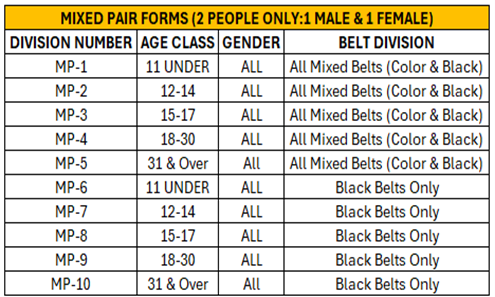
- Mixed Belts Pair Division
- Gender: A female Color Belt athlete may pair with either a male Color Belt or a male Black Belt. Or a male Color Belt athlete may pair with a female Color Belt or a female Black Belt.
- Age & Rank: As shown in the table above, the Mixed Pair divisions for Mixed Belts are organized into 5 distinct categories based on the age of the competitors.
- MT-1 through MT-6: These divisions are divided by specific age brackets as seen above.
- Poomsae: The team must perform a Taegeuk Poomsae (Color Belt Poomsae).
- Black Belt Team Division
- Gender: Both partners must be Black Belts (One male and one female).
- Age & Rank: As shown in the table above, the Mixed Pair divisions for Black Belts are organized into six distinct categories based on the age of the competitors. MT-6 through MT-10: These divisions are strictly for Black Belts only and are divided by specific age brackets.
- Poomsae: Each team must perform one Black Belt Poomsae of their choice.
QUESTION: How many Team Form divisions are there, and what are the rules?
There are two (2) categories available for the Team divisions:
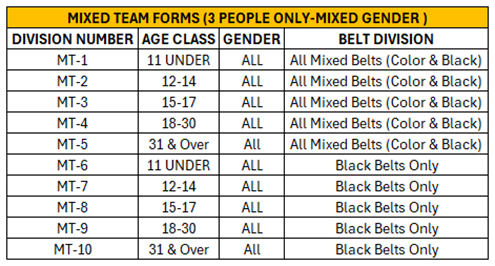
- Mixed Belts Team Division
- Gender: No restrictions. Any combination is allowed (e.g., 2 Males/1 Female, 3 Females, or 3 Males).
- Age & Rank: As shown in the table above, the Mixed Team divisions for Mixed Belts are organized into 5 distinct categories based on the age of the competitors.
- MT-1 through MT-6: These divisions are divided by specific age brackets as seen above.
- Poomsae: The team must perform a Taegeuk Poomsae (Color Belt Poomsae).
- Black Belt Team Division
- Gender: There are no restrictions on gender. Mixed gender teams are permitted and encouraged.
- Age & Rank: As shown in the table above, the Mixed Team divisions for Black Belts are organized into six distinct categories based on the age of the competitors.
- MT-6 through MT-10: These divisions are strictly for Black Belts only and are divided by specific age brackets.
- Poomsae: Each team must perform one Black Belt Poomsae of their choice.
QUESTION: How does the Open Poomsae division work, and what are the rules?
Open Poomsae Curriculum
The Open Poomsae division allows practitioners from various martial arts styles to demonstrate their forms. The following rules apply:
1. Color Belt Division
- Taekwondo Practitioners: May perform any Taegeuk or Palgwae Poomsae.
- Other Martial Arts Practitioners: May perform any Color Belt form (Kata/Hyung) recognized by their respective martial arts style or school.
2. Black Belt Division
- Taekwondo Practitioners: May perform any official Black Belt Poomsae.
- Note: A 1st Degree Black Belt is permitted to perform higher-rank forms (e.g., 2nd or 3rd Dan Poomsae) without any penalty.
- Other Martial Arts Practitioners: May perform any Black Belt form (Kata/Hyung) recognized by their respective martial arts style or school.